
Do Goldendoodles actually have a lower cancer risk than the Golden Retrievers and Poodles used to create them?
Nationwide's insurance data found a dramatically lower cancer-claim risk in Goldendoodles. Goldendoodles had a relative cancer-claim risk of 47.4%, compared with 195.3% for Golden Retrievers and 143.5% for Standard Poodles. This shows a strong association, although insurance-claim data cannot prove that crossbreeding itself caused the difference.
Nationwide Pet Insurance has one of the largest real-world canine health databases available. Its veterinary analytics team analyzed cancer claims from 1.61 million insured dogs over six years, including Golden Retrievers, Standard Poodles and Goldendoodles. (Nationwide Newsroom)
Goldendoodles Had Far Fewer Cancer Claims
Nationwide compared each breed's relative risk of having an insurance claim submitted for cancer.
| Breed | Relative Cancer-Claim Risk |
|---|---|
| Golden Retriever | 195.3% |
| Standard Poodle | 143.5% |
| Goldendoodle | 47.4% |
These percentages are relative cancer claim risk, not the percentage of dogs diagnosed with cancer. For example, 195.3% means Golden Retrievers had about 1.95 times the cancer claim risk of the overall dog population.
Golden Retrievers had almost twice the average cancer-claim risk. Standard Poodles were also substantially above average. Goldendoodles, however, had less than half the average cancer-claim risk. These figures come directly from Nationwide's Oodles of Doodles: Popularity and Health report.
How Big Was the Difference?
Nationwide Insurance calculated the combined cancer claim risk of Golden Retrievers and Standard Poodles and compared that population with Goldendoodles. Their conclusion:
Goldendoodles were 75% less likely to have a cancer claim than their Golden Retriever and Standard Poodle parent breeds combined.
Nationwide also reported that the parent breeds had approximately four times the relative cancer-claim risk of their Goldendoodle offspring population.
Looking at the individual breeds tells a similar story:
Golden Retriever: 195.3%
Standard Poodle: 143.5%
Goldendoodle: 47.4%
Both purebred populations used to create the Goldendoodle had substantially higher cancer-claim rates than the Goldendoodle population itself. Nationwide's own summary states that Golden Retrievers and Standard Poodles were 3.8 times more likely to have a cancer claim than Goldendoodles. You can read Nationwide's summary of the analysis here.
Learn more about why generation alone does not determine health in our blog article F1, F1b, F2 & Multigenerational Doodles Explained.
Why Could Crossing Two Breeds Make a Difference?
A Golden Retriever and a Poodle come from two genetically distinct breed populations. An F1 Goldendoodle receives approximately: 50% Golden Retriever genetics and 50% Poodle genetics. Bringing together two different genetic populations generally increases heterozygosity, or genetic diversity, while reducing the chance that the puppy receives identical sections of DNA from both sides of its family.
This can be particularly important for recessive disease variants, because many recessive diseases require a puppy to inherit the same harmful variant from both parents. Research across dog breeds has also found an association between greater genomic inbreeding and increased need for non-routine veterinary care. A study of 227 dog breeds found both inbreeding and body size were significantly associated with morbidity. Read the UC Davis-led study on inbreeding and canine health.
This does not prove that increased genetic diversity caused the lower Goldendoodle cancer-claim rate, but it provides a biologically reasonable explanation that deserves further research.
This Does Not Mean Goldendoodles Cannot Get Cancer
Goldendoodles can absolutely develop cancer. The Nationwide analysis measured insurance claims for cancer diagnosis and treatment, not the lifetime percentage of dogs that will eventually develop cancer. It was also an observational analysis. Nationwide did not control these particular comparisons for every factor that might influence cancer risk, such as:
age, body size, weight, environment, nutrition
Nationwide itself describes the work as a single-variable analysis and cautions against interpreting the association as proof of cause and effect. The Nationwide data show that Goldendoodles had dramatically fewer cancer claims.
This Pattern Was Not Limited to Goldendoodles
Nationwide also studied Labradoodles. Labrador Retrievers and Standard Poodles had substantially higher cancer-claim risk than Labradoodles. Nationwide reported that Labradoodles had a 62% lower cancer-claim risk than their two parent breeds combined.
Purebred dogs as a group had approximately 1.9 times the relative cancer-claim risk of crossbred and mixed-breed dogs.
What Does This Mean for Responsible Goldendoodle Breeding?
The Nationwide results do not mean that simply breeding any Golden Retriever to any Poodle will automatically create a healthier dog. The parents still matter enormously. At Safari Doodles, we believe the strongest approach combines the potential benefit of genetic diversity with:
OFA health testing, DNA testing, family health history, careful parent selection and knowledge of what previous generations have produced. We have continued our purebred lines of Golden Retrievers and Poodles for many generations due to their repeated good health data. Learn more about how Safari Doodles health tests our parent dogs using OFA screening, DNA testing and family health information.
Crossbreeding gives breeders something that cannot be achieved when breeding only within one closed breed population: the opportunity to introduce an entirely different set of genetics. The Nationwide cancer data give us a fascinating real world example of how dramatically the health statistics of a crossbred population can differ from both of its parent breeds.
Second Study on Cancer in Golden Retrievers vs Goldendoodles
Another Study Shows a Strong Golden Retriever Cancer Signal
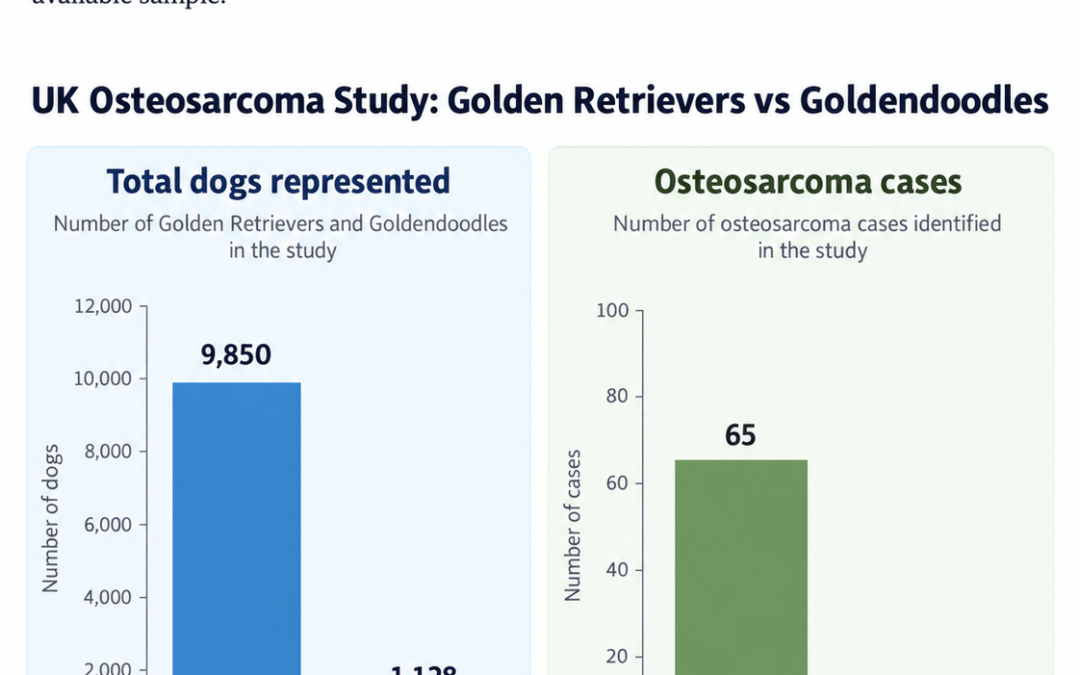
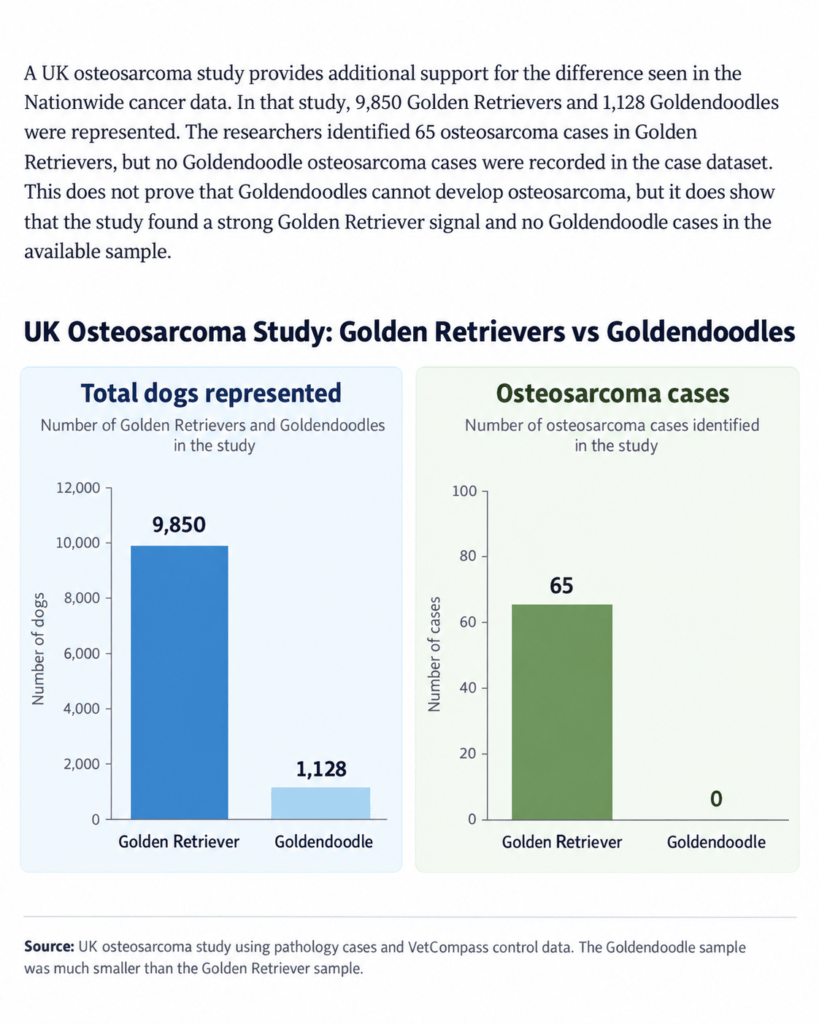
A separate UK case-control study provides another interesting piece of evidence. Researchers identified 65 Golden Retriever osteosarcoma cases, while no Goldendoodle cases were recorded in the pathology case dataset. The comparison population contained 9,785 Golden Retrievers and 1,128 Goldendoodles. Because this was a case-control study rather than dogs followed prospectively throughout life, these numbers should not be interpreted as lifetime cancer rates. However, the study identified Golden Retrievers as having significantly increased odds of osteosarcoma, while no Goldendoodle cases were identified in the available pathology sample.
Read the full study here:
https://pmc.ncbi.nlm.nih.gov/articles/PMC7944903/
The Bottom Line
Nationwide Insurance analyzed cancer claims from more than 1.6 million dogs.
The relative cancer-claim risks were:
Golden Retriever: 195.3%
Standard Poodle: 143.5%
Goldendoodle: 47.4%
Nationwide concluded that Goldendoodles were 75% less likely to have a cancer claim than Golden Retrievers and Standard Poodles combined.
This does not prove that every Goldendoodle will be healthier or that crossbreeding alone caused the difference. But it does provide unusually large real-world evidence showing that the Goldendoodle population had substantially fewer cancer claims than either of the purebred populations used to create it.
Learn more about the health testing, parent dogs, and breeding practices behind Safari Doodles Goldendoodle puppies in Texas.
Sources
Nationwide: Oodles of Doodles — Original White Paper
Nationwide: Popular Poodle-Cross Pups Outpacing Purebred Parents
The Effect of Inbreeding, Body Size and Morphology on Health in Dog Breeds
Recent Comments