
Yes, Cavapoos and Goldendoodles can shed, but the amount varies widely. Coat shedding is influenced more by the specific genes a puppy inherits, especially RSPO2 and MC5R genes, than by whether the dog is simply labeled F1, F1b, or a certain percentage Poodle.
One of the most common reasons families are attracted to Cavapoos and Goldendoodles is the possibility of having a dog that sheds much less than a Cavalier King Charles Spaniel or Golden Retriever.
But not every Doodle coat is the same. Some Cavapoos and Goldendoodles release almost no noticeable hair, while others shed considerably more. You may also see Doodles with straight coats, loose waves, or tight curls.
Why?
The answer is genetics.
Today, DNA testing allows us to understand many of the genes responsible for a dog's coat. This gives breeders much more information than simply looking at whether a puppy is an F1, F1b, or a certain percentage Poodle.
The Same Coat Genes Work in Cavapoos and Goldendoodles
A Cavapoo receives coat genes from a: Cavalier King Charles Spaniel + Poodle
A Goldendoodle receives coat genes from a: Golden Retriever + Poodle
Although these two non-Poodle parents are different breeds, the basic genes controlling furnishings, shedding, curl, and coat length work the same way in both crosses.
Four particularly useful genes are:
| Gene | What it helps determine |
|---|---|
| RSPO2 | Furnishings and an important influence on shedding |
| MC5R | Degree of shedding |
| KRT71 | Straight, wavy or curly coat |
| FGF5 | Hair length |
Large canine genetic studies have shown that just a small number of genes account for a remarkable amount of the coat variation we see among dogs. A landmark study of more than 1,000 dogs from 80 breeds identified RSPO2, FGF5 and KRT71 as major genes controlling furnishings, coat length and curl. (PubMed)
RSPO2: The Furnishings Gene
The first gene to understand is RSPO2. In Doodle breeding, this is commonly called the furnishings gene. Furnishings produce the longer facial hair that creates the familiar Doodle appearance, including the:
beard
moustache
eyebrows
longer facial coat
A Cavalier or Golden Retriever has the traditional unfurnished face. A Poodle has furnishings. The furnishing variant is dominant, meaning a dog generally needs only one copy to show furnishings. (Embark). This is why an F1 Doodle can have the classic furnished Doodle face even though only half of its ancestry is Poodle.
For example, if a Poodle has two furnishing copies and is bred to an unfurnished Cavalier or Golden:
Poodle F/F × Cavalier or Golden I/I the F1 puppies receive: F/I and are furnished, genetically. But not all FI dogs express full furnishings. Not every furnished dog expresses furnishings to exactly the same degree. Animal Genetics, for example, tests both the standard furnishings variant and a second furnishings associated variant called F², which may produce less pronounced furnishings. Many commonly used DNA panels do not currently report this additional F² variant.
Furnishings also matter for shedding
This is where RSPO2 becomes particularly important. Research has found that RSPO2 is not merely an appearance gene. It also has a strong relationship with how much hair a dog sheds.
A large genome-wide study found that both RSPO2 and MC5R were significantly associated with shedding, with minimal-shedding breeds such as Poodles and Bichons carrying the furnished RSPO2 form. (PubMed Central (PMC))
This means the beard and eyebrows are more than a cosmetic trait. Furnishings give us information about one of the genetic systems associated with the low-shedding coat.
MC5R: Another Important Shedding Gene
The second major gene is MC5R. Think of MC5R as helping determine the dog's natural tendency to release hair. Current canine DNA testing identifies versions of MC5R associated with lighter versus heavier or seasonal shedding. (Embark)
But there is an important interaction: RSPO2 (furnishing gene) can modify the effect of MC5R (shedding gene)
Furnished dogs generally tend to be lower shedding even when their MC5R result would otherwise predict more shedding. (Embark). That means predicting a Doodle's coat isn't always as simple as looking at one “shedding gene.”
The genes work together.
KRT71: The Curl Gene
Another common misconception is that: curly = non-shedding
That isn't necessarily true. The KRT71 gene is strongly involved in whether a long-haired dog's coat develops as:
straight
wavy
or curly
Dogs carrying the curl-associated form of KRT71 are more likely to have wavy or curly coats, while dogs without it are more likely to have straighter coats. (PubMed)
But curl and shedding are different genetic traits. A relatively straight or loosely wavy furnished Cavapoo or Goldendoodle may shed very little. Likewise, simply seeing curls on a puppy does not by itself prove that the dog will be non-shedding. A great example of this is the Curly Coated Retriever. This dog has a pretty curly coat and sheds very heavily just like a Labrador Retriever.
This is why Safari Doodles does not judge shedding potential by curl. In fact, many dogs with very straight coats are as low shed as is possible.You do not need a curly coat to have very low shedding. Yorkshire Terriers and Maltese can have very straight coats, while Havanese may have straighter or wavier coats, yet all three are known as very low shedding breeds. This is another good example of why curl alone does not determine shedding.
FGF5: The Coat-Length Gene
FGF5 is one of the primary genes determining whether a dog's coat is genetically long or short. (PubMed)
Poodles, Golden Retrievers and Cavaliers all have long-coated phenotypes, so Doodles from these breeds generally inherit the genetics needed for a longer coat. What makes one coat look silky like a Cavalier, flowing like a Golden, or fluffy and curly like a Poodle is the interaction between coat length and the other coat genes. That interaction of multiple genes creates the tremendous coat variety we see in Cavapoos and Goldendoodles.
To learn more about our Goldendoodle parent dogs, sizes, health testing, coat types, and breeding program, visit Safari Doodles Mini and Medium Goldendoodles in Texas.
Why Two Doodles From the Same Litter Can Look Different
Every puppy receives one set of DNA from its mother and another from its father. But littermates do not receive exactly the same combination. The first puppy may inherit more curl. A second puppy may inherit a straighter coat. The third puppy may inherit a different combination of shedding-associated variants. That means puppies with exactly the same parents can have noticeably different adult coats.
This is normal genetics.
Does F1, F1b or Poodle Percentage Tell Us How Much a Doodle Will Shed?
A Doodle's generation gives us some information, but it doesn't tell the whole story.
An F1 Cavapoo is approximately: 50% Cavalier + 50% Poodle
An F1 Goldendoodle is approximately: 50% Golden Retriever + 50% Poodle
An F1b produced by breeding an F1 back to a Poodle averages approximately: 75% Poodle
For many years, breeders used Poodle percentage as one of the main ways of predicting coat and shedding. An F1b was assumed to be more likely to have a low-shedding coat simply because it had more Poodle ancestry. Today we have better information available. Yes, Cavapoos and Goldendoodles can shed, but the amount varies widely. Coat shedding is influenced more by the specific genes a puppy inherits, especially RSPO2 and MC5R, than by whether the dog is simply labeled F1, F1b, or a certain percentage Poodle.
A dog's actual coat genes are more informative than a generation label alone.
DNA testing can tell us whether the parents carry genes associated with furnishings, shedding, curl and coat length. Modern tests such as Embark report RSPO2, MC5R, KRT71 and FGF5 directly. (Embark)
That allows us to evaluate the genetics of the actual dogs being bred instead of relying only on percentages.
Are Cavapoos and Goldendoodles Hypoallergenic?
This is where the terminology gets confusing! There is no dog breed or coat type that can be guaranteed to be hypoallergenic. PubMed article
People who are allergic to dogs generally react to proteins produced by the dog. Those allergens can be present in saliva, skin secretions and dander and can become attached to hair and spread throughout the environment. So a dog producing very little loose hair can still produce allergens. For this reason, low shedding and hypoallergenic do not mean the same thing.
A better description is: low shedding or very low shedding
No dog can be promised to be hypoallergenic. For families with significant dog allergies, we recommend spending time around many dogs before deciding whether a Cavapoo or Goldendoodle will be appropriate for their household.
What Does “Low Shedding” Actually Mean?
All dogs shed. Yes, you read that correctly.
All dogs shed
A low-shed or casual term of 'non-shed' dog, is a dog who grows each hair follicle for many inches prior to shedding that hair out. All hair grows, ages and is replaced. The major difference is the amount of loose hair released into the environment. How long does it take for a dog to shed its hair?
All dogs replace old hairs with new hairs, but the rate at which those hairs are released varies tremendously. In many low-shedding breeds, individual hairs remain in the active growth phase for a much longer period before entering the resting and shedding phases. This is why a Poodle can grow a very long coat while releasing relatively little loose hair into the home. So “non-shedding” does not literally mean that a dog never loses a hair. It means that the coat releases so little loose hair that the shedding may be barely noticeable.
A low-shedding Doodle may leave very little visible hair on:
furniture
clothing
floors
bedding
but the coat usually requires regular brushing and grooming because much of the loose hair can remain caught within the coat rather than simply falling away. This is why Doodles and Poodles mat easily. And why they need very regular brushing and hair cuts.
There is a trade-off: less hair around your house means more coat maintenance on the dog.
Why DNA Testing Has Changed Doodle Breeding
Coat prediction used to rely heavily on appearance, pedigree and generation. Those things are still useful. But breeders can now directly examine many of the genes responsible for the coat. At Safari Doodles, we can combine:
At Safari Doodles, we combine DNA coat testing with the parents' actual coats, the coats produced in previous litters, and our knowledge of multiple generations of each family. We have bred Doodles since 2009, giving us many years of experience observing how different combinations of coat genetics are actually expressed in adult dogs. Those litters, produced from a wide variety of genetics, have taught us a great deal about predicting coat type.
That is a significant improvement over simply saying: “This puppy is 75% Poodle, so it shouldn't shed.”
There are plenty of higher generation Doodles who shed quite a lot.
Cavapoo and Goldendoodle Coats Are Genetics, Not Guesswork
Cavapoos and Goldendoodles can both be wonderful choices for families wanting a dog that sheds substantially less than many traditional shedding breeds. But we believe families deserve a better explanation than simply calling every Doodle “hypoallergenic.”
The science is much more interesting.
A Doodle's coat is created by the combination of genes inherited from both parents. By understanding furnishings, shedding, curl and coat length, we can make much better predictions about the coat a puppy is likely to develop. And as DNA technology continues to improve, responsible breeders have increasingly powerful tools to help families choose a puppy whose coat is a good match for their lifestyle.
To learn more about our Cavapoo parent dogs, sizes, health testing, and breeding program, visit Safari Doodles Cavapoo puppies in Texas.
Scientific Sources
Coat type genetics — NIH/Science study
Coat Variation in the Domestic Dog Is Governed by Variants in Three Genes
More than 1,000 dogs from 80 breeds; establishes the major roles of RSPO2, FGF5 and KRT71. (PubMed Central (PMC))
Shedding genetics — Cornell/Nature Communications
Complex Disease and Phenotype Mapping in the Domestic Dog
Analyzed thousands of dogs and identified the important interaction between RSPO2 and MC5R in shedding. (PubMed Central (PMC))
Current DNA coat traits — Embark
Embark's Tested Coat Traits
Shows that current testing includes RSPO2, MC5R, KRT71 and FGF5. (Embark)
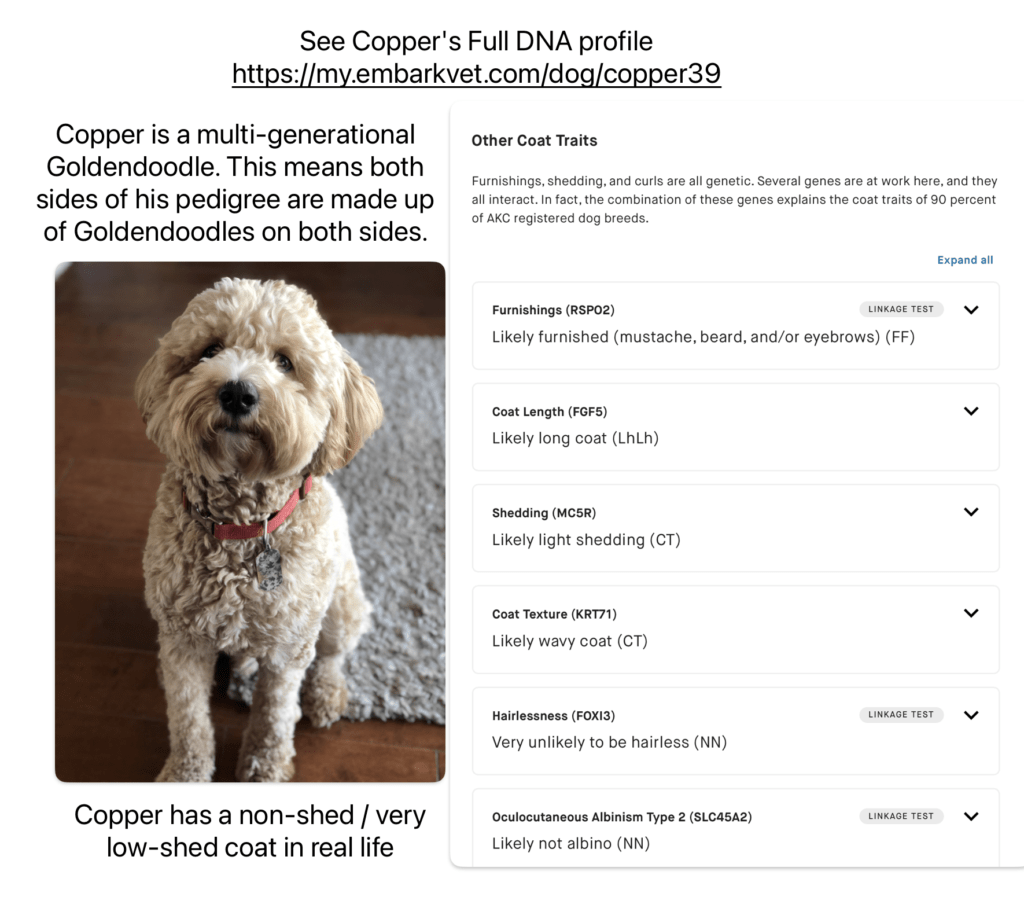
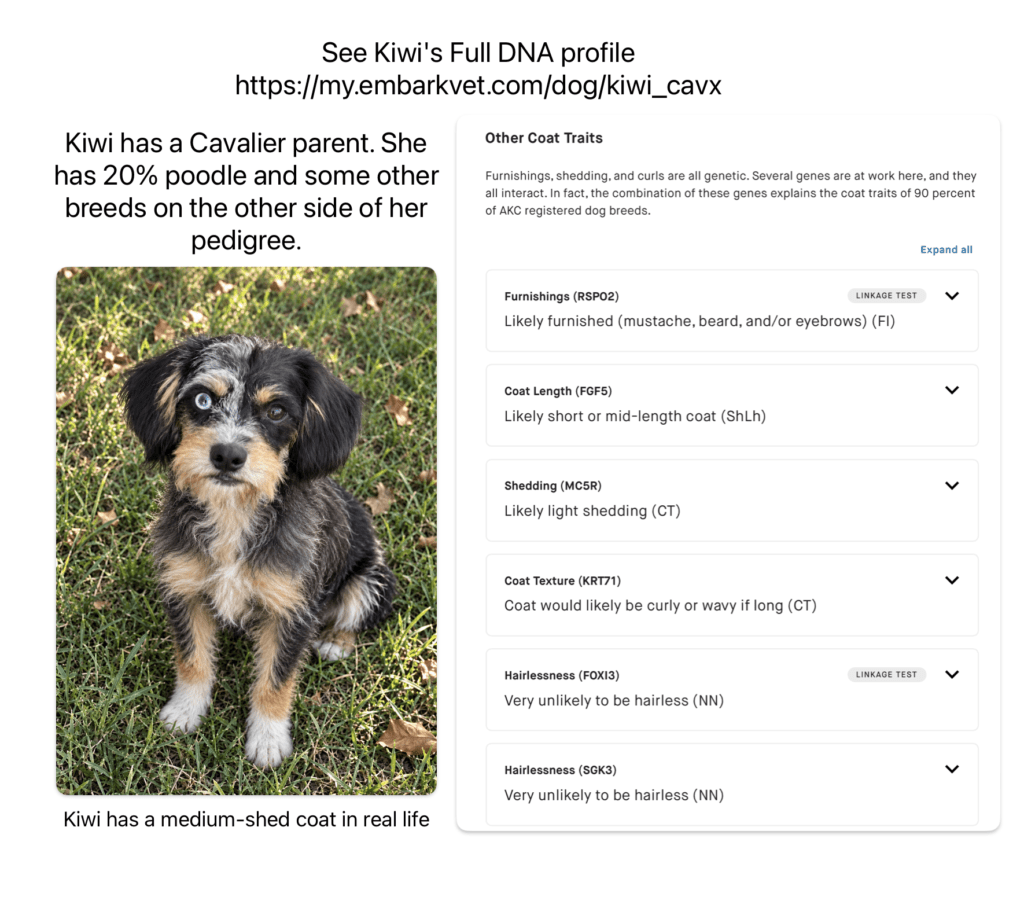
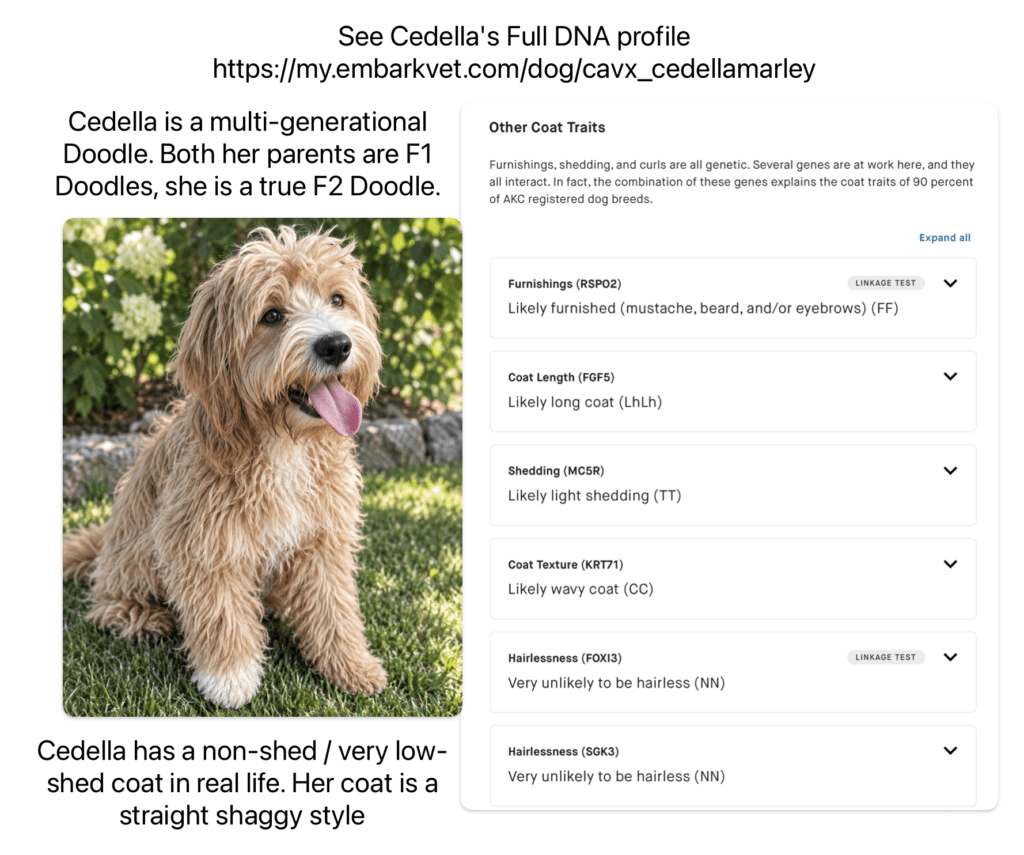
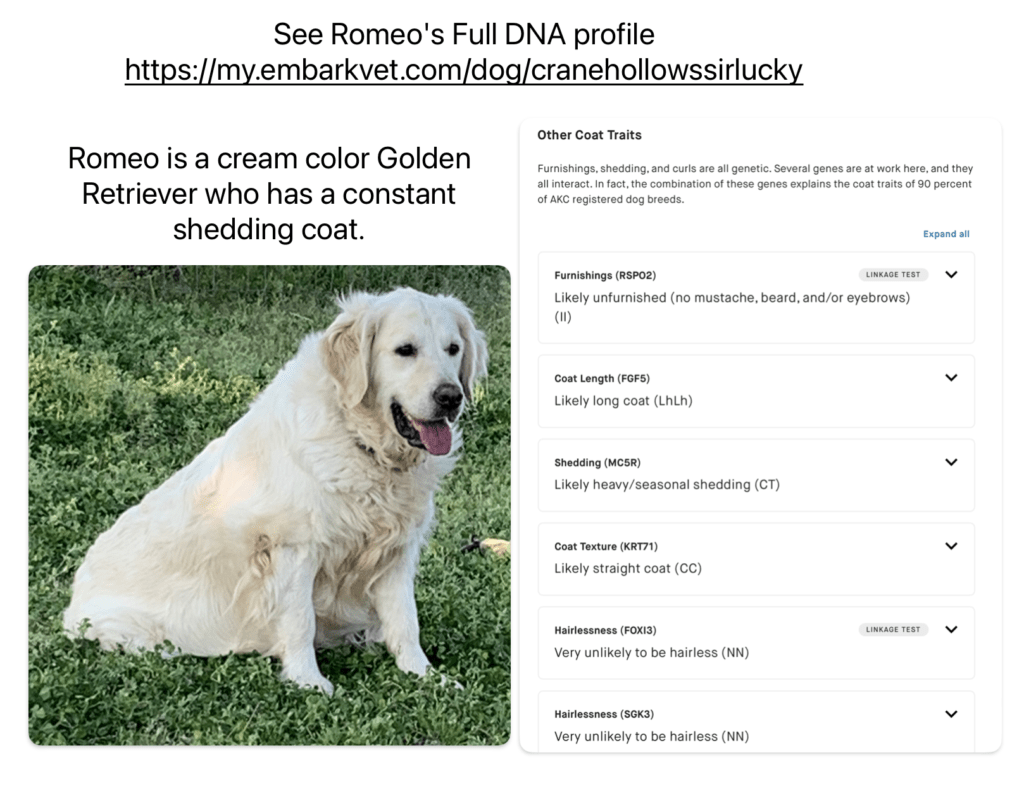
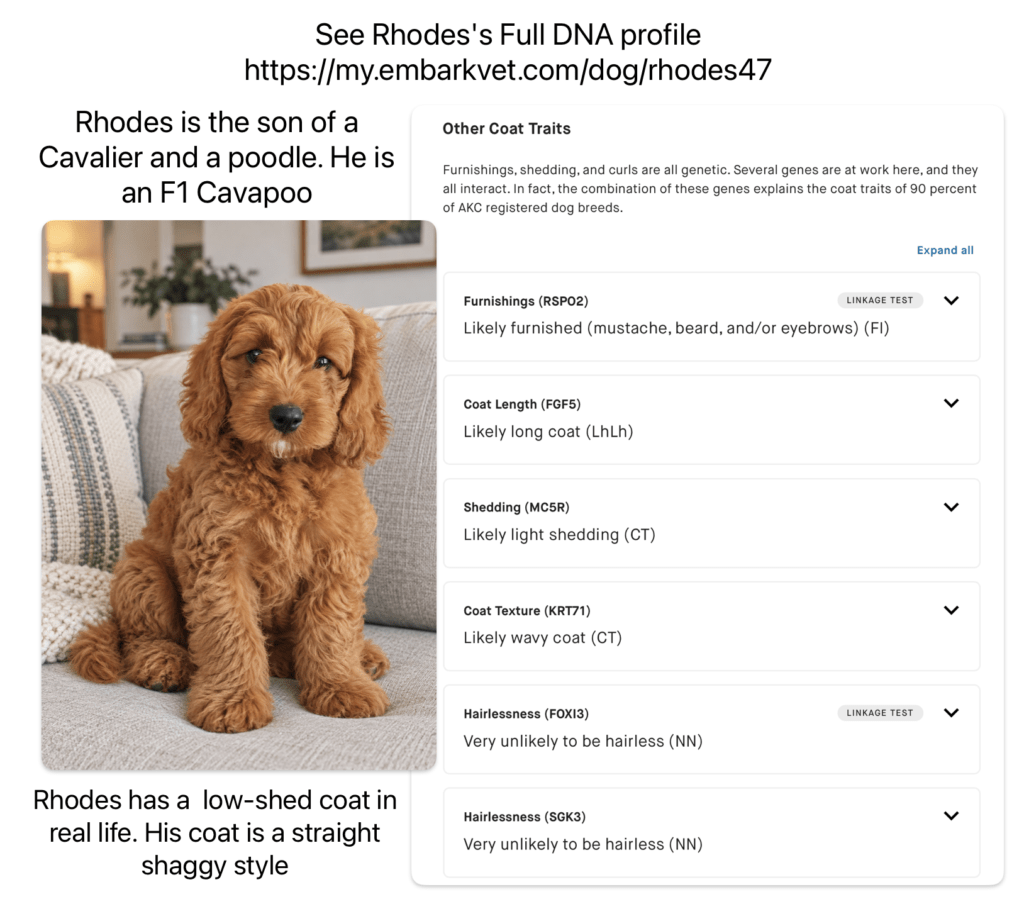
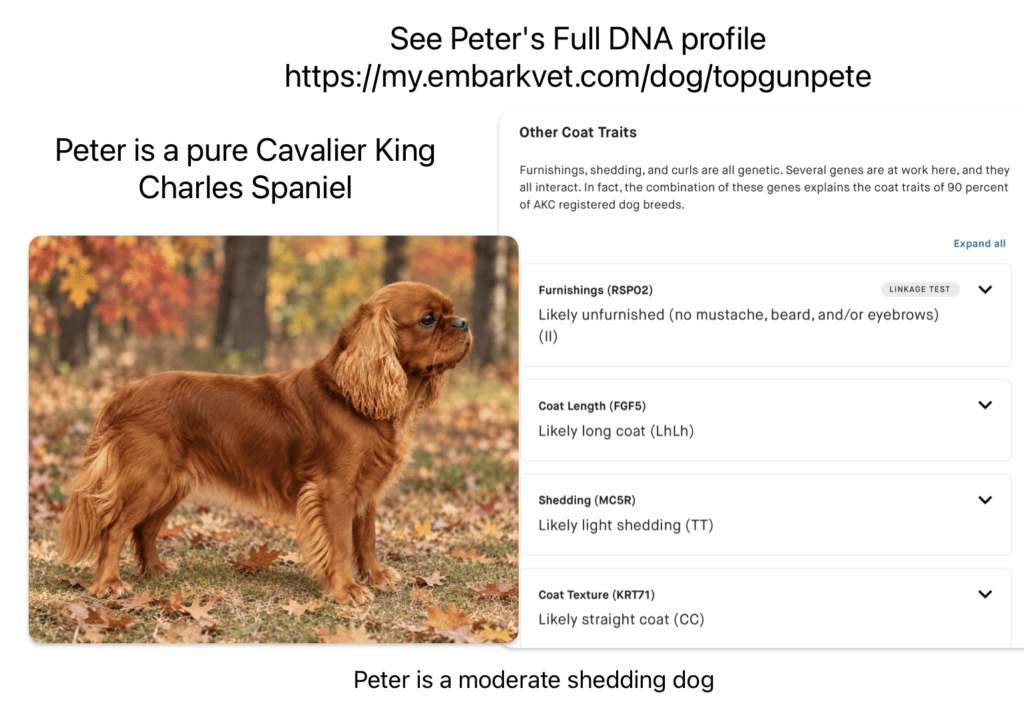
Real Dogs: Comparing DNA Coat Genetics With the Actual Coat
The dogs below are dogs we know personally. We have included their DNA coat results alongside photographs of their actual coats and our observations of how much they shed in real life. This allows you to see how coat genetics translate into the dog you actually see and live with.
Recent Comments